Blog » M&A Playbooks
How Stuart Faught Turned Simple Ideas Into 20 SaaS Exits
The repeatable playbook behind Stuart Faught’s 20 micro-SaaS exits on Acquire: niche focus, partner distribution, clean docs, and selling at the right stage.
By David Mitchell, Founder of Ventura, SaaS M&A specialist · Published 2026-06-01 · 9 min read
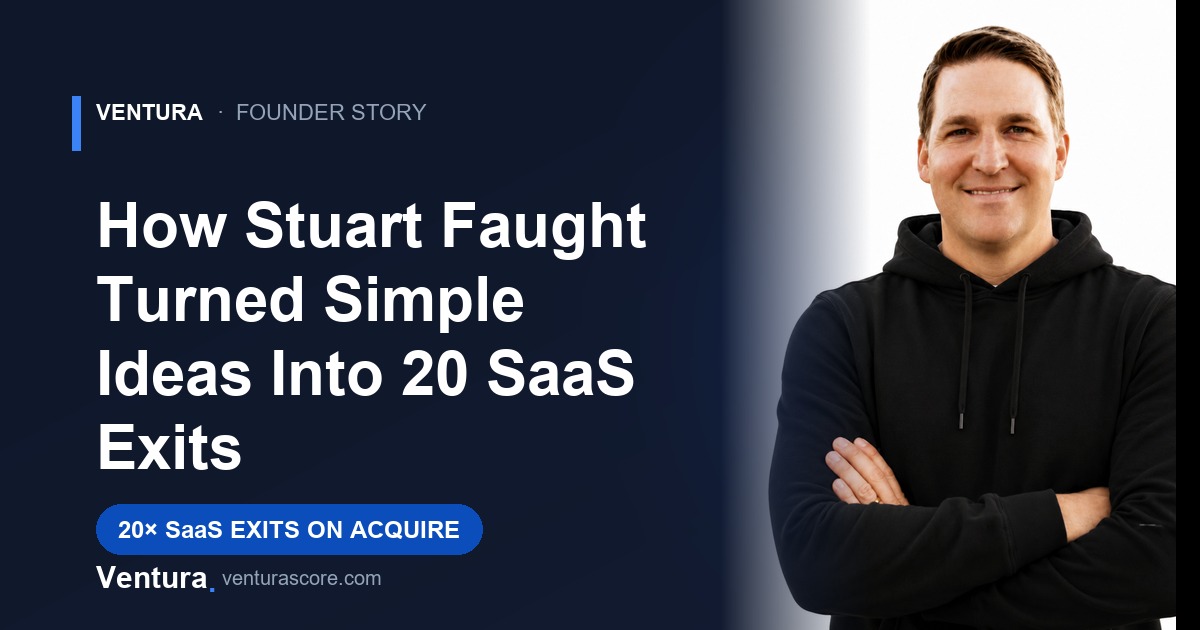
Most founders spend a decade chasing one enormous outcome. They raise venture money, hire aggressively, and bet everything on a single company becoming the thing that defines their career. Stuart Faught built his entire approach around the opposite idea. Over roughly fifteen years he started, grew, and sold around twenty small software businesses, and in doing so he quietly assembled one of the most repeatable exit track records in the bootstrapped SaaS world.
His story matters because it dismantles almost everything first-time founders believe they need. No computer science degree. No funding round. No viral growth hack. Just a clear understanding of who he was selling to, disciplined operations, and the patience to sell each business at the exact stage where it was worth the most. If you are a bootstrapped founder wondering whether your small SaaS could ever be worth a meaningful check, Stuart is the proof that the answer is yes, provided you treat the sale as a craft rather than a lottery ticket.
Out of the Cubicle and Into a Niche
Stuart graduated in 2008, walking straight into one of the worst job markets in living memory. The job he found was about as unglamorous as it gets: a cubicle in Southern California, selling software to dental practices. It was repetitive, the ceiling was low, and the work belonged to someone else. But it taught him something that would shape the next decade of his life. He learned how a specific type of business actually buys software, what they care about, what makes them nervous, and how a salesperson earns their trust.
By 2010 he had seen enough. He left to build his first venture, an SEO service aimed squarely at dentists. There was nothing flashy about it. It was small, it was specific, and it solved a problem he understood intimately because he had spent years sitting across the table from exactly these customers. That single decision, choosing a narrow audience he already knew rather than a broad market he did not, became the spine of everything that followed.
The First Real Exit
The dental SEO work evolved into something bigger: an online reputation management product for local businesses. This was Stuart’s first taste of building genuine recurring software revenue rather than selling a service one project at a time. The product found its footing and eventually signed up thousands of customers, a serious base for a solo founder working a tight niche.
In 2018 he sold it. That sale was the moment the pattern clicked into place. He realized he did not have to marry a business for life to make it worthwhile. He could build something real, grow it to a healthy size, hand it to a buyer who was excited to run it, and start again with everything he had learned. What most founders experience once, if they are lucky, Stuart was about to turn into a routine.
One Playbook, Repeated Twenty Times
Over the following years Stuart ran the same loop again and again across a string of unglamorous, deeply practical industries. Dental. Orthodontics. HVAC. Med spas. Home care. None of these are the kind of markets that get written up in tech press, and that was precisely the point. They were full of business owners with real budgets and real problems, and almost no one was building software specifically for them.
His first principle was to stay narrow on purpose. A product built for one vertical gains traction far faster than a general tool trying to be everything to everyone, because the messaging, the features, and the sales pitch can all speak directly to one type of customer. When a niche started to feel crowded, he did not pivot wildly. He stepped sideways into an adjacent market that shared the same DNA, moving from med spas to plastic surgeons, for example, where the buying behavior and the problems rhymed.
His second principle was distribution through trust rather than paid acquisition. Instead of pouring money into ads and fighting rising costs, Stuart built relationships with the consultants and advisors these industries already relied on. At one point he was working with more than two hundred industry consultants who had spent years earning their clients' confidence. A simple demo webinar, delivered to an audience that already trusted the messenger, did more than any ad campaign could. He borrowed credibility instead of buying attention.
His third principle was to keep the business clean and legible from day one. He was obsessive about documentation, not because he loved paperwork, but because he knew it directly shortened the painful diligence phase of a sale. As he put it, a clear Trello board immediately shortens diligence. Walkthrough videos, tidy financials, and organized operations meant a buyer could understand the whole business quickly, trust what they were seeing, and move toward closing without months of back and forth.
And running underneath all of it was a conviction that quietly contradicts startup orthodoxy. Stuart never wrote the code himself, and he never saw that as a weakness. In his words, you do not need to be technical to own a tech company, and sales and marketing skills matter far more. He understood customers, he understood distribution, and he hired or partnered for the rest.
The Economics of Selling Small and Often
The financial logic behind Stuart’s approach is where it becomes genuinely instructive for bootstrapped founders. He was not waiting for a business to reach millions in revenue before considering a sale. His sweet spot was to grow a product to somewhere around fifty to one hundred thousand dollars in annual recurring revenue and then sell it, typically at a multiple of roughly five times top-line revenue. A product doing one hundred thousand dollars a year could change hands for something in the neighborhood of half a million dollars, and most of his deals closed within thirty to forty-five days.
He kept the structure deliberately boring, and that was a feature. A straightforward asset sale, full equity, at least half the money in cash upfront, and the remainder paid within ninety days. He had no interest in the kind of deals that load all the risk onto the seller. Zero-down offers and five-year payout plans were not worth his time, because they turned a clean exit into a long, uncertain entanglement. Simplicity protected him, and it also made him an easy, trustworthy counterparty for buyers.
Perhaps the most revealing thing about Stuart is his honesty about what he is actually good at. He found that his zone of excellence was the early stage, the part where a product is validated and pushed from nothing to a real, paying customer base. The grind of scaling a company from one million to ten million in revenue did not energize him the way the zero-to-traction phase did. So he built a career around playing only the part of the game he was best at, and handing each business off to someone who genuinely wanted the next chapter. As he describes it, selling is not giving up, it is choosing the stage where you produce your best work.
What He Looks For When the Roles Reverse
Because Stuart has sat on both sides of the table, his view of what makes a SaaS business buyable is unusually grounded. When he evaluates a company as a buyer, he digs into the things that actually predict whether the revenue will survive the handover. He reviews the code, he scrutinizes how sticky the revenue really is, and he goes straight to the source by talking directly with three to five existing customers to hear, unfiltered, why they pay and whether they intend to keep paying. He also expects a reasonable runway of seller support after the deal, often somewhere between ninety and one hundred eighty days, so the transition does not break what he just bought.
The buyers he most enjoys selling to tell you something about the kind of opportunity he believes in. They are frequently first-time founders making the leap from employment into ownership, people who want a real business generating real cash flow without having to invent it from scratch. A clean, well-documented, profitable SaaS in the few-hundred-thousand-dollar revenue range is, for that buyer, a life-changing asset. Stuart spent years building exactly those assets and matching them with exactly those buyers.
The One Lesson Worth Stealing
It would be easy to read Stuart’s record as a story about hustle or volume, but that misses the real lesson. His advantage was never speed or sheer output. It was readiness. Every business he sold was sellable long before he listed it, because he ran each one as if a buyer might look under the hood at any moment. The documentation existed. The financials were clean. The revenue was understandable. The dependency on him personally was kept low enough that someone else could step in.
This is the part most founders get wrong, and it is the most expensive mistake in the entire process. They build for years and only start thinking about a sale once they have decided to exit, at which point they discover their operations are a mess, their numbers are hard to defend, and the whole company quietly runs on the founder’s own head. By then the discount is already baked in. Buyers can feel the lack of preparation, and they price it accordingly. The founders who got paid, in Stuart’s experience, were the ones who prepared. The ones who left money on the table were the ones who did not.
That gap between a business that merely makes money and a business that is genuinely ready to be sold is exactly what Ventura was built to close. It gives founders an honest read on what their company is worth today, and a specific, prioritized list of the gaps to fix before a buyer ever asks the hard questions. Stuart spent fifteen years learning that readiness is the whole game. The goal here is to hand you that same edge from the start.